
Imagine your sales team has a VIP line for product demos. Who gets to skip to the front? Lead scoring is the system that acts as your bouncer, deciding who gets in based on how ready they are to buy. It's a way to rank prospects, making sure your most valuable demo slots go to your most interested buyers.
What Is Lead Scoring for Sales Demos?
Think of lead scoring as a "demo readiness filter." Instead of your Go-to-Market (GTM) team treating every single lead the same, this system assigns points to each one. This score gives your sales reps a crystal-clear signal, helping them instantly spot who's hot and who's not. It's a simple but powerful way to focus energy on the most crucial part of the sale: the demo.
In the old days, lead scoring was a clunky, manual process. Teams would cobble together a few rules based on gut feelings and basic data points like job title or company size. You can learn more about how this has changed by reading up on predictive lead scoring. Today, with a little help from AI, the whole game is much smarter and more dynamic, especially when it comes to optimizing how your sales team conducts demos.
The Two Pillars of Scoring Data
At its core, modern lead scoring pulls in data from two key areas to paint a full picture of a prospect's potential.
Explicit Data: This is the stuff a lead tells you about themselves. Think of the information they fill out on a form—company size, industry, their job title. This data answers the question: Is this the right kind of person from the right kind of company?
Implicit Data: This is all about behavior. It's what you observe them doing. Did they visit your pricing page? Download an ebook? Spend ten minutes clicking through an interactive demo? This data answers a different, but equally important, question: How interested are they right now?
A truly hot lead scores high in both categories. Imagine a VP of Engineering (strong explicit fit) from a key target account who just spent 15 minutes exploring your product's interactive demo (high implicit intent). That's someone your team needs to call immediately.
To truly understand how this works in practice, you need to break down the components. A modern scoring model combines these data types to assess a lead's fitness and intent.
Core Components of Modern Lead Scoring
Component | Description | Example for Demo Readiness |
|---|---|---|
Demographic Data | Individual characteristics of the person, such as their job title, department, or seniority level. | A "Director" or "VP" title in a relevant department (e.g., Marketing, Sales) gets more points than an "Intern." |
Firmographic Data | Characteristics of the company, including industry, revenue, and number of employees. | A lead from a target industry like "SaaS" with over 250 employees scores higher. |
Behavioral Data | Actions the lead takes on your website or with your marketing materials. Tracks their engagement level. | Visiting the pricing page (+10 points), watching a webinar (+15), or completing an interactive demo (+25). |
Email Engagement | How the lead interacts with your email campaigns, such as opens and clicks. | Opening a specific demo-focused email might be +5 points, while clicking a link inside is +10. |
Social Engagement | Interactions with your brand on social media platforms like LinkedIn. | Commenting on a company post or following your page shows active interest. |
By blending these different data streams, your team can finally move beyond guesswork. They get a clear, data-backed view of who is just kicking the tires and who is raising their hand, ready to buy. This ensures every live demo is a high-impact conversation with a genuinely qualified prospect.
Why Scoring Is Critical for High-Impact Demos

Without a system to pick out your best prospects, your sales team is essentially flying blind. They end up giving the same generic demo over and over, just hoping something sticks. This is where the whole concept of what is lead scoring stops being a marketing buzzword and becomes a vital sales weapon. It’s the bridge that connects raw interest to a powerful, personalized product demo.
This process has a massive impact on your Go-To-Market (GTM) team's success by making sure their energy is spent in the right places. Instead of chasing lukewarm leads, sales reps can zero in on prospects who are actually signaling they're ready to buy. That alignment is the bedrock of any modern demo strategy that gets real results.
Turning Data Into Demo Personalization
The real magic of lead scoring is how it helps you shape the story you tell in a demo. A high score isn't just a number; it’s a breadcrumb trail showing you what a prospect cares about. Did their score jump because they kept visiting your API documentation, or was it because they read a case study from their own industry?
That’s intel your sales reps can use to ditch the one-size-fits-all script. They can tailor the demo to hit on the exact pain points and use cases that matter to that specific person, making the entire experience far more compelling. For instance, if a high-scoring lead spent a ton of time in an interactive demo clicking around a particular feature, that's exactly what you should lead with on the live call.
A personalized demo feels less like a pitch and more like a solution. When you understand a prospect's journey before the call even starts, you can turn a standard presentation into a focused conversation that builds trust and moves the deal forward.
This data-first approach makes every single sales conversation better. The effect on the bottom line is huge—companies that get this right see some serious returns. In fact, research shows that businesses using lead scoring see an average 77% boost in their lead generation ROI. That's because the best leads, the ones scoring between 55 and 90, end up making up about 80% of all purchases. You can dig into the full findings on how scoring impacts buying behavior on llcbuddy.com.
Improving Demo Delivery with AI Support
As more sales teams embrace this way of thinking, AI is becoming an indispensable sidekick. Today's AI tools can sift through scoring data to suggest talking points or even help pre-qualify leads through smart, automated interactive demos. This kind of AI support for sales and GTM teams means that by the time a rep gets on a live product demo, they’re armed with a ton of insight.
Here’s a quick look at how AI support improves the most crucial part of the sale:
Focus on High-Value Conversations: AI cuts through the noise, so reps are only talking to people who are truly ready for a demo.
Hyper-Personalized Narratives: AI can spot engagement patterns, helping reps build a demo story that resonates with a prospect’s unique challenges.
Smarter Resource Allocation: Not every lead needs a full, hour-long live demo. AI can help guide lower-scoring leads to interactive demos where they can explore on their own and qualify themselves further.
By weaving in AI support, GTM teams can make sure every single demo is a high-impact event, which ultimately drives more conversions and strengthens the entire sales pipeline.
How AI Is Changing the Lead Scoring Game

The old, rules-based scoring models were a decent start, but they were never more than a simple checklist. An AI-powered system, on the other hand, is like a master detective. It connects dozens of seemingly unrelated clues to build a complete picture of a lead’s real intent.
This is where the idea of what is lead scoring goes from a static ranking to a dynamic, predictive engine.
Traditional systems are completely reliant on rules you have to set by hand, which get stale almost as soon as you create them. AI models are different. They churn through thousands of data points in real-time—from website clicks to how someone interacts with an interactive demo. By digging through all that information, AI finds subtle patterns in behavior that a person would simply never see.
This is the jump to what we call predictive lead scoring. Instead of just counting actions, the AI predicts how likely someone is to convert by looking at the behavior of thousands of your past leads. It’s the difference between seeing a lead visited your pricing page, and knowing that leads who visit the pricing page after trying a specific feature in your interactive demo convert at a 3x higher rate.
From Static Rules to Adaptive Intelligence
The biggest game-changer with AI is its ability to learn and adapt. A manual scoring model is frozen in time until someone gets around to updating it. An AI model, however, is constantly refining its own algorithm with every new sales outcome.
When a high-scoring lead signs a contract, the AI goes back and analyzes every touchpoint that led to that win. It then reinforces those successful patterns in its model. On the flip side, if a lead with a top score ghosts your sales team, the AI learns from that failure and adjusts its criteria.
This continuous feedback loop means your scoring model never goes stale. It evolves right alongside your customers' buying habits, making sure your go-to-market (GTM) teams are always working with the freshest, most accurate intelligence possible.
This adaptive intelligence has a huge impact on the sales process, especially when it comes to the demo.
Optimizing the Demo Experience with AI
AI-powered scoring gives sales teams a massive advantage by helping them make smarter decisions about how to engage each prospect. It doesn't just spit out a number; it provides the why behind the score, giving reps a clear path to personalize their approach.
The system can intelligently sort leads based on their predicted needs and where they are in their buying journey, which makes your entire demo strategy more efficient.
High-Scoring Leads: A prospect with a score of 95 who has already explored key features in an interactive demo and checked out your integrations page is ready for a real conversation. The AI flags this lead for immediate, one-on-one outreach from a sales rep.
Mid-Scoring Leads: Someone with a score of 60 is clearly interested but might not be ready for a full-on sales pitch. The AI can automatically point this person toward a self-guided interactive demo, letting them explore the product on their own terms and warm up further.
Low-Scoring Leads: Leads with minimal engagement? They get put into a nurture campaign, saving your sales team’s valuable time for the hotter prospects.
By automating this sorting process, AI helps sales and GTM teams stop giving generic, one-size-fits-all demos. Instead, they can deliver the perfect experience—whether that’s a hands-on interactive demo or a strategic, rep-led conversation—to the right person at the perfect moment. The result is a big lift in conversion rates.
Weaving AI Scoring into Your Sales Workflow
Bringing AI into your sales process isn’t as simple as flipping a switch. It’s more like building a new highway for your Go-to-Market (GTM) team. You need a solid, step-by-step plan to create an intelligent scoring system that truly changes how you schedule and deliver every single product demo.
The first, and most important, step is to figure out what a 'demo-qualified' lead really means for your business. This is much deeper than just looking at basic demographics. It's about digging into the data on your best customers to find the common threads—the specific job titles, the behaviors they exhibit, and the engagement signals that consistently turn into closed deals. This definition becomes the true north for your entire AI model.
Next, you've got to bring all your data together. An AI model is only as good as the information you feed it. That means pulling data from every tool in your GTM stack—your CRM, marketing automation platform, and product analytics—into one unified view. A complete dataset like this lets the AI connect dots a human might never see, like how interacting with a specific feature on your website correlates with a much shorter sales cycle.
Choosing and Training the AI Model
With your data all in one place, it's time to focus on the AI model itself. Picking the right platform is key. You need something that can not only crunch the numbers but also learn from your actual sales results. The initial training involves giving the model a ton of historical data on both won and lost deals. The AI sifts through all of it, identifying the subtle combinations of attributes and actions that are the best predictors of success.
This whole process is a loop: define what matters, assign scores, and then refine the model based on what happens.
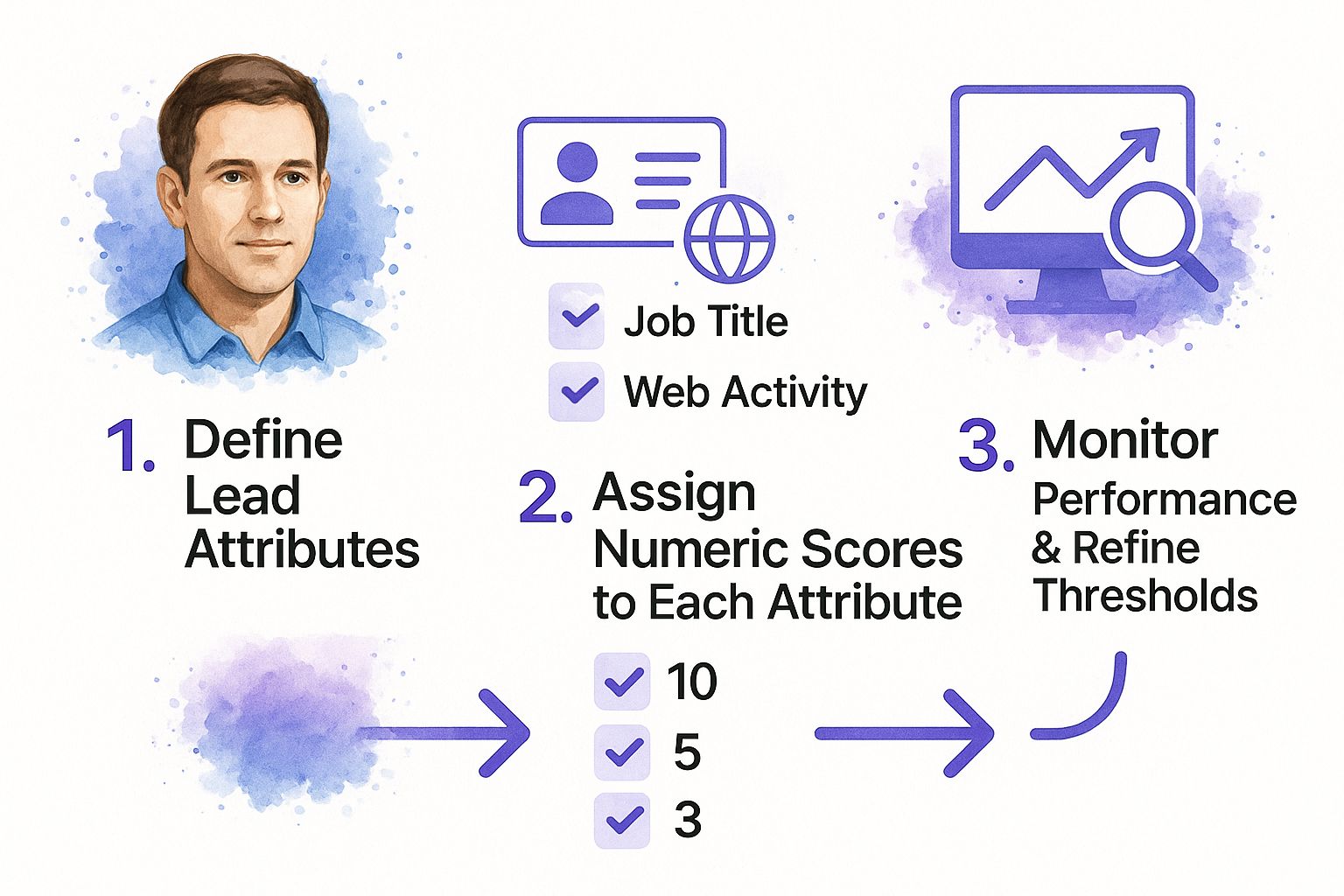
As you can see, getting this right isn’t a set-it-and-forget-it task. It’s an ongoing cycle of monitoring, learning, and improving.
Turning Scores into a Smarter Demo Strategy
Once the model is trained and running, you can set up smart thresholds that automatically send leads to the right place. This is where AI moves your demo strategy from a one-size-fits-all approach to something perfectly tailored to each prospect.
High-Scoring Leads (score of 85+): These folks are practically waving their hands, showing clear intent to buy. The system should fast-track them directly to your sales team for a live, one-on-one product demo.
Mid-Scoring Leads (score of 50-84): This group is definitely interested, but they might not be ready for a sales call just yet. They're the perfect audience for a self-guided interactive demo, letting them explore your product on their own terms and qualify themselves.
Low-Scoring Leads (score under 50): Instead of wasting a salesperson's time, these leads can be automatically placed into a long-term nurturing sequence.
But here’s the most critical part: you have to close the loop. Every time a deal is won or lost, that outcome needs to be fed back into the AI. This continuous feedback is what ensures the system keeps learning and adapting, making your lead scoring—and by extension, your demo process—smarter every single day.
Modern platforms are designed for exactly this. For example, Aidvize uses AI-driven conversational avatars inside realistic product demos to help pre-qualify leads before they ever talk to a human. Exploring tools that support this kind of intelligent demo routing shows how AI support for sales teams stops being a buzzword and becomes a real, practical advantage.
Best Practices for AI-Informed Sales Demos
So, your shiny new AI-powered lead scoring system is humming along, pointing you straight to your most promising prospects. Great. But that's only half the job. Knowing who to talk to is a massive win, but the real test is how you talk to them. This is exactly where the old-school, one-size-fits-all product demo completely falls flat.
To really make the most of your lead scoring data, your entire demo strategy needs a refresh. It’s time to move from a monologue to a dialogue, and you can use the lead score as your conversation starter. A high score isn't just a number; it's a story. Did they get a bump in their score after reading three blog posts about a specific integration? That’s your cue.
Your sales team can now craft a demo that zeros in on the features that actually matter to that person. It’s the difference between a generic presentation and a true problem-solving session. This AI support is a game-changer for sales teams, especially when it helps you build a more flexible, multi-touch demo experience. Because let’s be honest, not every hot lead is ready for a live, one-on-one call right out of the gate.
Creating a Blended Demo Strategy
A smart demo strategy uses AI to figure out the right kind of demo for each prospect based on their score and what they've been doing. It’s all about meeting buyers where they are. Some people really do need the human touch of a sales rep, while others would much rather explore on their own first.
AI can pinpoint the perfect candidates for a self-guided interactive demo. These might be people from the right kind of company who are just starting to poke around. By sending them to an interactive experience, you let them discover your product on their own terms, whenever they want.
This approach has some serious perks:
Self-Qualification: Prospects figure out if you're a good fit for them by playing with the features they care about. This, in turn, feeds even richer data back into your scoring model.
Warms Up Leads: It gets them comfortable with your product and builds their confidence before they ever hop on a call with sales.
Saves Rep Time: Your sales team ends up spending their valuable time talking to people who are already engaged and educated.
This modern, multi-touch strategy ensures that by the time a lead gets to a live demo, they are not just qualified, but genuinely invested. The conversation becomes less about "what our product does" and more about "how our product solves your specific problem."
Modern Demos Versus Outdated Approaches
The difference between a traditional demo and an AI-informed one is night and day. The old way was clunky and impersonal, treating every prospect the same. The new way is precise, personal, and way more effective at closing deals. It’s a necessary step for any Go-to-Market (GTM) team that wants to stay competitive.
Let's look at how the old way of doing things stacks up against a more modern, AI-backed strategy that incorporates different types of demos.
Traditional Demo vs AI-Informed Demo Strategy
The table below breaks down just how much has changed. We've moved from a brute-force approach to a far more intelligent and respectful way of engaging with potential customers.
Aspect | Traditional Demo Approach | AI-Informed Demo Approach |
|---|---|---|
Audience Targeting | One-size-fits-all; delivered to anyone who fills out a form. | Precision-targeted; live demos reserved for high-scoring, sales-ready leads. |
Content | A generic script covering all features, regardless of relevance. | A tailored narrative focused on the specific pain points and interests identified by AI. |
Initial Engagement | Forces all leads into a live demo, often prematurely. | Routes leads to the right experience—a live call or a self-guided interactive demo. |
Sales Rep Role | A presenter, reciting a script and hoping something resonates. | A strategic consultant, using data to guide a problem-solving conversation. |
Outcome | Lower engagement, longer sales cycles, and wasted resources. | Higher conversion rates, shorter sales cycles, and a more efficient GTM team. |
Ultimately, weaving AI into your demo process is about more than just being efficient. It’s about creating a better, more thoughtful buying experience that people actually appreciate, helping you turn those well-informed leads into happy, long-term customers.
The Future Is an Intelligent Demo Strategy
Lead scoring isn't just a marketing tool anymore; it has grown into something far more strategic. Think of it as the brain behind a smarter sales approach, especially when it comes to orchestrating the entire demo experience. With AI in the mix, modern systems don't just flag a warm lead. They tell you who is ready for a demo, what features they're most interested in, and even how they'd prefer to see your product in action.
This is a massive shift for sales and go-to-market leaders. It redefines what sales enablement can be. Instead of every demo being a one-size-fits-all pitch, AI helps turn it into a pointed, high-impact conversation. This means you can get tactical, sending interactive demos to prospects who are still in the exploration phase and saving your team's valuable time for live demos with people showing clear signs they're ready to buy.
The future of sales isn’t about cranking out more demos. It's about delivering the right demo to the right person at the perfect moment—and with AI, that's no longer a pipe dream.
Common Questions About AI Lead Scoring
Stepping into AI-powered scoring can feel like a major leap, but it’s one of the most impactful moves you can make to improve how your sales team approaches demos. Let's tackle some of the common questions GTM leaders have when they start digging into this technology.
How Is Predictive Lead Scoring Different From Traditional Scoring?
Think of traditional, rules-based scoring as a simple checklist. You decide what's important and manually assign points for certain actions, like +10 for a form fill. It’s a good start, but it’s static and relies heavily on your own assumptions.
Predictive lead scoring, on the other hand, is like having a data scientist on your team. The AI sifts through thousands of data points from your past deals—both won and lost—to find the subtle, complex patterns that actually signal a future customer. It's a dynamic system that constantly learns and adapts, moving far beyond human guesswork.
What’s the First Step to Implement AI Lead Scoring?
Before you can do anything else, you need to conduct a data audit. It all starts with a deep dive into your historical data.
The goal is to get crystal clear on the common traits of your best customers. What does a genuine "demo-qualified lead" actually look like for your business? This initial analysis creates the benchmark—the foundation—that your AI model will build on.
How Do Interactive Demos Fit into an AI Strategy?
Interactive demos are the perfect answer for leads who are intrigued but not quite ready to talk to a salesperson. An AI scoring system is smart enough to spot these prospects. It can see the buying signals but also recognize they aren't ready for a live call just yet.
Instead of pushing them into a sales conversation they'll reject, the system can automatically route them to an interactive product demo. This lets them explore your product's value on their own terms and self-qualify, effectively warming them up for a more productive sales chat down the road.
Can AI Lead Scoring Work for a Small Sales Team?
Absolutely. In fact, it can be a game-changer for smaller teams. When you have limited resources, you can't afford to waste time on dead-end leads.
AI lead scoring automates the entire prioritization process, making sure your reps spend their precious time on the opportunities most likely to close. Even with a smaller dataset to start, modern AI models can quickly begin to identify winning patterns and make your team incredibly more efficient.
Ready to transform your demo strategy with AI? Discover how Aidvize uses intelligent, conversational avatars in realistic product demos to pre-qualify leads and accelerate your sales cycle. See how it works at https://aidvize.com.
Article created using Outrank